

The Tao of Letting Go
How Winnie the Pooh Does Without Trying

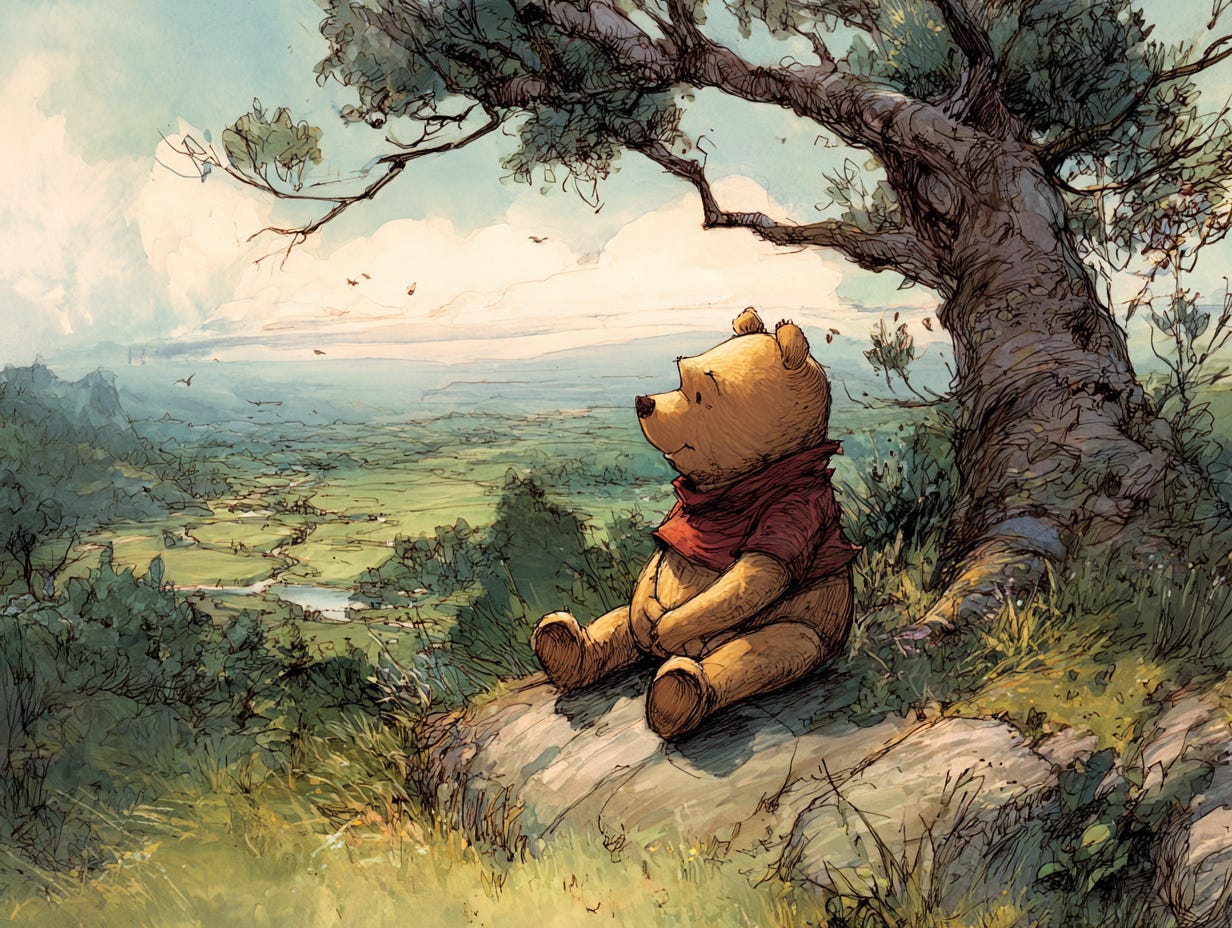
The Tao of Pooh by Benjamin Hoff, Like Musashi by Eiji Yoshikawa, is a book that changed me. The funny thing about change is that sometimes it doesn’t stick. Life throws it challenges at you: kids, work, ambition, fear, the unexpected, and as you adapt, dodge weave, and distract yourself, you lose sight of the ideas that once felt obvious.
When I first read The Tao of Pooh, (ages ago), I had a lot less on my plate. I was young, doing more thinking, more wandering, more questioning of what it meant to be human. One thing I kept circling back to was that most of our friction in life comes from desire. That constant hunger for something just out of reach. More certainty. More clarity. More things. More control...
It was the perfect time to stumble onto a book that basically said, “Stop trying so hard.”
In a nutshell, the Tao of Pooh uses Winnie the Pooh to explain Taoism. And strangely, it works. Pooh’s whole philosophy is rooted in presence, simplicity, and an acceptance most of us have forgotten how to practice.
He is not wise in an intellectual sense. If anything, he’s the least “educated” character in Hundred Acre Wood. But the thing is, wisdom isn’t always found in intellect. Most times it’s found in the absence of overthinking.
Pooh never forces life to fit his expectations. He doesn’t wrestle with his identity the way we do. He doesn’t optimize or plan like rabbit, overthink like owl, spiral into worry like Piglet, or sink into Eyeore’s pessimism. He just moves through the world as he is: curios, open and unaffected.
He flows.
In Taoism that’s called Pu, (I know) the Uncarved Block. It’s the state of being untouched by complication. It’s simple, natural and is the whole state of being who you are before the world chisels you into something else.
What I love about the book, isn’t its explanation of Taoism itself, (although that is really well done). Its how he used Pooh to illustrate the one thing we’re terrible at: letting go. Pooh is never at odds with himself. He’s not trying to “improve.” He doesn’t spend his days trying to become a better bear. He simply is a bear. And for him, that’s always enough.
We live in a world obsessed with becoming. Better, richer, more productive, more optimized. We avoid stillness like it’s failure. We carry our invisible list of traits or goals we think we need to accomplish to earn our place here.
Pooh would look at that list, shrug, and ask if anyone wanted to go for a walk and look for honey.
He is not trying to become someone.
He is simply expressing who he already is.
That’s the gift of the book. It encourages you to let go. To stop measuring yourself against something external. To stop believing your one goal away from becoming better.
Taoism isn’t anti-effort. It isn’t laziness, apathy or giving up. It’s the recognition that fighting the current doesn’t make the river respect you. Most of the suffering we create for ourselves comes from insisting the world operate how we imagine it should, instead of the way it actually does.
When I first read the book, I didn’t realize how quickly I’d abandon its lesson. Not intentionally. It just happened. Life accelerated. Responsibilities multiplied. And slowly, without noticing, I began to live like everyone else. Reactive, hurried, tangled in desire, convinced that clarity was hiding just out of reach.
Re-reading it now, years later, it hits different. It made me realize what I’ve complicated. What I’ve tightened that I should have loosened instead. It reminded me that the simplest truths don’t stop being true just because we drift or forget them. They’re always there. They’re just waiting for us to slow down long enough to hear them again.
My quiet takeaway?
Is painfully simple:
You don’t need to chase a different life to be whole. You need to stop resisting the one you already have.
I hate paywalls. They kill curiosity and reward clickbait. That’s why the core content here will always be free.
But this takes time, thought, and energy. If it helps you see the world differently, consider supporting it by buying me a coffee or becoming a paid subscriber for exclusive content, audio versions of each essay (coming soon), and deeper dives.
Thanks for being here. Stay Curious. Question Everything.
–Luis